What to Do When a Parent Can't Live Alone
There is a long distance between 'fine on their own' and 'needs a care home', and almost everything worth doing happens in that gap. This page is about how to tell which end of it you are actually at, how to raise it without a fight, and what the real options are in between — including the ones nobody mentions until you ask.
Free forever • No credit card • iOS & Android
The Problem
Sound familiar? You're not alone.
You are not sure whether this is a genuine safety threshold or your own anxiety after one bad phone call
Every conversation about it ends in defensiveness, tears, or a flat refusal to discuss it again
You suspect they are covering things up — tidying before your visits, minimising a fall, changing the subject about a letter from the doctor
Your siblings see a different parent to the one you see, and cannot agree on whether anything needs to change
The only options anyone has offered you are 'leave it' or 'a home', and neither of them is right
You do not know what a care needs assessment is, who pays for what, or where to even start looking
You are afraid that raising it will damage the relationship, and afraid that not raising it will cost more than that
How I'm Alive Solves This
A simple solution that actually works.
Separate the signals that genuinely indicate risk from the ones that are just ageing — a single fall, unopened post, weight loss and medication errors mean something different to a slower walk or a messier kitchen
Write down what you have actually observed, with dates, before you talk to anyone. Specific observations are far harder to dismiss than 'I'm worried about you', and they are exactly what a professional assessment will ask for
Ask for a formal assessment rather than making the judgement yourselves. In England a care needs assessment from the local council is free and anyone can ask for one, and the NHS states it can result in equipment such as a personal alarm, changes to the home, or practical help from a paid carer. In the United States, the Eldercare Locator on 1-800-677-1116 — a public service of the Administration for Community Living — connects families to local services
Work through the middle options in order of least disruption: home adaptations, a daily check-in, telecare equipment, meal and shopping delivery, a few hours of paid home care each week, day centres, live-in care, sheltered or assisted housing. A care home is the last item on a long list, not the second
Start the conversation from what they want to protect rather than from what you are afraid of — most people will accept a great deal of help in order to stay in their own home, and almost none will accept help framed as evidence that they are failing
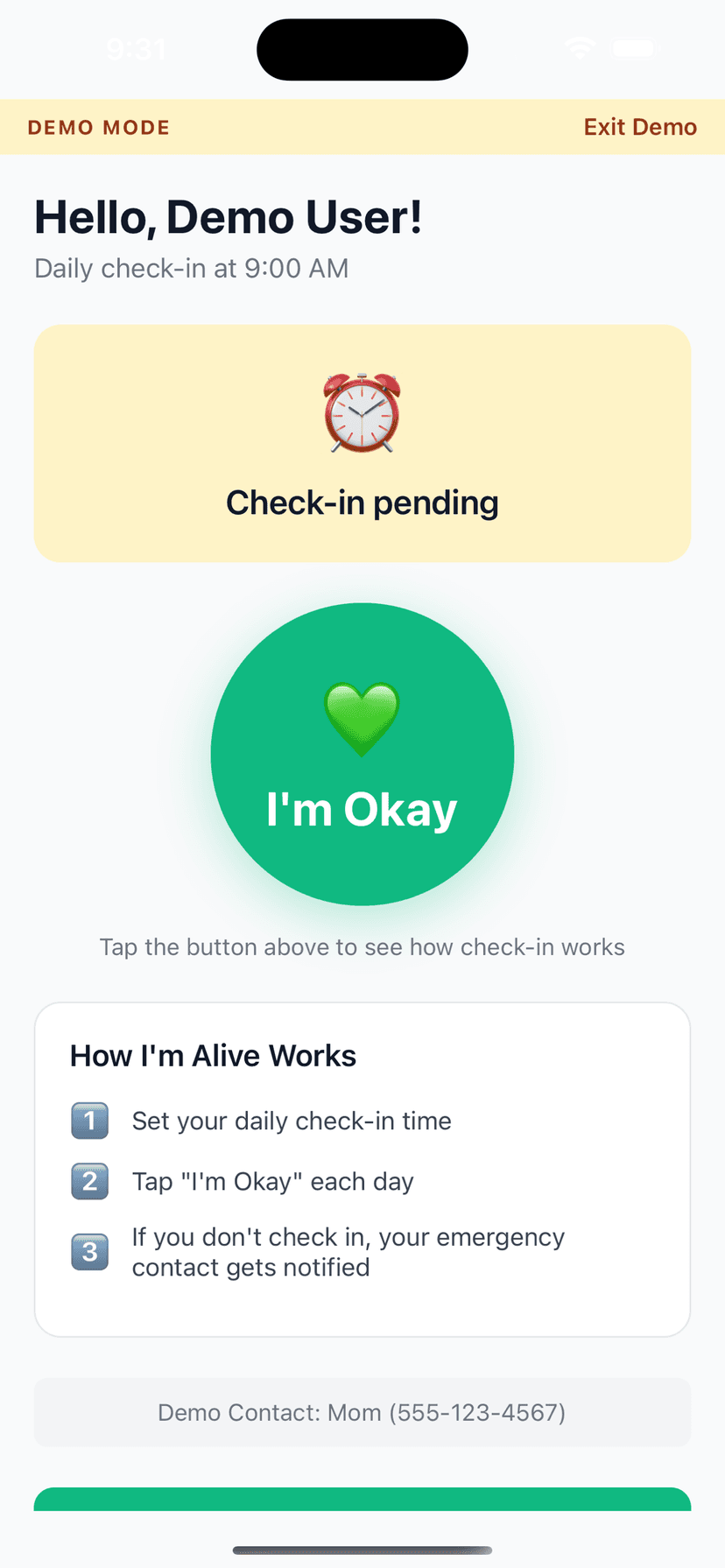
Fix the noticing problem first, because it is cheap and reversible. A daily check-in with automatic alerts to you means an unnoticed fall becomes a same-day event rather than a three-day one, and it buys time to make the bigger decision properly rather than in a crisis
Get one sibling conversation done separately from any conversation with your parent, so that you arrive with one position rather than a family argument they have to referee
How It Works
Three simple steps.
Set Your Time
Choose when to check in each day
Tap I'm Okay
One tap confirms you're safe
Auto-Alert
Miss a check-in? Contact is notified
Features
One-Tap Check-In
Large, easy button - done in seconds
Customizable Schedule
Set your perfect check-in time
Smart Alerts (Protect Me)
Escalating notifications to your contacts if you miss a check-in
Check-In Notes
Add context like 'Going hiking today'
History Tracking
See all your past check-ins
Free to Start
Daily self check-in and reminders are always free; add Protect Me for contact alerting
Frequently Asked Questions
What are the signs that a parent can no longer live alone?
Some changes are ageing and some are thresholds. The ones that carry real weight are: a fall, especially an unreported one; medication being missed or doubled; unopened post and unpaid bills; unexplained weight loss or an empty fridge; getting lost on a familiar route; leaving the cooker on; declining personal hygiene; and withdrawal from things they previously never missed. A slower walk, a messier house or forgetting a name is not in the same category. What matters most is the direction of travel and whether the person can still recover from a bad day on their own.
Is it my decision to make?
Usually not, and this is the hardest part. An adult with capacity is entitled to make choices you consider unwise, including staying somewhere you think is unsafe. In England and Wales the Mental Capacity Act 2005 states the principle directly: a person must be assumed to have capacity unless it is established otherwise, and is not to be treated as unable to make a decision merely because they make an unwise one. Capacity is also decision-specific — someone may be unable to manage their finances while entirely able to decide where they live. Where capacity is genuinely in question, ask for a professional assessment rather than deciding within the family.
How do I start the conversation without it turning into a row?
Pick a calm moment that is not immediately after an incident, and open with a specific observation rather than a conclusion — 'I noticed the letters from the surgery were unopened' lands very differently from 'you're not coping'. Ask what they would want to happen if they had a fall and could not get up; that question invites them to plan rather than to defend. Offer the smallest possible change first. And accept that this is rarely one conversation: most families need three or four over a few months, and the early ones are only there to make the later ones possible.
What are the options between living alone and a care home?
Far more than most families are told. Home adaptations such as grab rails, a walk-in shower or a stairlift. Telecare — a personal alarm, sensors, an automatic daily check-in. Meal and shopping delivery. A few hours of paid home care a week, which can be as little as help with a shower and a check on the medication. Day centres and lunch clubs, which address isolation as well as safety. Live-in care. Sheltered, retirement or assisted living housing, where the person keeps their own front door. Moving closer to family, or a family member moving closer. A care home is the end of that list, not the alternative to the start of it.
Who pays for care, and how do I find out what we are entitled to?
Ask for an assessment before you spend anything. In England, a care needs assessment from the local council is free and anyone can ask for one; the NHS states you may be entitled to free home adaptations and equipment provided they cost less than £1,000 each, and that this is not means-tested. Care itself is means-tested separately through a financial assessment. In the United States, entitlements are determined locally, so the useful first call is the Eldercare Locator on 1-800-677-1116; Medicaid home and community-based services waivers fund different things in different states, and some Medicare Advantage plans include supplemental benefits worth checking in your own plan documents.
My siblings disagree about whether anything needs to change. What now?
Two things usually resolve this. First, replace impressions with a shared written record — each of you notes what you actually observe, with dates, over a few weeks. Siblings often genuinely see different parents, because the person performs wellness for the visitor who comes least often. Second, bring in an outside assessment, which removes the argument from the family: a professional saying what they see is far easier for everyone to accept than a sibling saying it. If disagreement persists, it is usually about guilt, money or old family roles rather than about the parent, and naming that is more productive than another round of the same argument.
Where does a daily check-in app fit into this decision?
It addresses one specific part: the time before anyone notices something is wrong. If a parent lives alone and falls, the risk is often less the impact than the hours afterwards — among older people found helpless or dead at home, mortality was 67% for those down more than 72 hours against 12% for those found within an hour (Gurley et al., NEJM 1996). A daily check-in shortens that window to about a day for very little money, which often buys the time to make the larger decision calmly. What it does not do is provide care, summon an ambulance, or work for someone who can no longer reliably respond to a prompt. I'm Alive's daily check-in is free on iPhone and Android; automatic alerts to your contacts start at $29.99 a year; we have no monitoring centre and never call emergency services.
How is this different from your page on an elderly parent living alone?
That page is about supporting a parent who is living alone safely and how to keep it that way — the daily arrangements that make independence sustainable. This page is for the point at which you are no longer sure it is sustainable, and you are trying to work out whether that is true and what to do about it. If your parent is managing and you simply want a safety net, start there. If you are asking whether they should still be on their own at all, you are in the right place.
My mum lives alone and says she is fine. How do I know if she really is?
Assume the report is optimistic and look at the evidence instead, because most people minimise, and they minimise hardest to the child they most want to protect. Look at what is physically visible: the fridge, the pill organiser, the pile of post, the state of the bathroom, whether the bins went out. Look at second-hand signals: has the GP surgery called, have neighbours mentioned anything, has she stopped going to something she never used to miss. And visit at an unexpected time — many families discover the gap between the performance and the reality only when they arrive on a Tuesday morning instead of a planned Sunday lunch. None of that is spying. It is the same evidence a professional assessment would collect, and gathering it before you raise anything means the conversation starts from observation rather than accusation.
What if my parent lives independently now but I know this is coming?
Then you are in the best possible position, and the useful work is almost all preparation rather than intervention. Put the paperwork in place while it is easy: lasting power of attorney in the UK, a healthcare proxy and durable power of attorney in the US, both far simpler to arrange before anyone is unwell. Agree now what they would want at each stage, including which kinds of help they would accept and which they would find intolerable — that conversation is worth more later than any device. Do the low-friction practical things while they are uncontroversial: a key with a neighbour, a current medication list, a daily point of contact, grab rails before rather than after the first fall. And establish the habit of talking about it at all, so that the difficult conversation in three years is the tenth one rather than the first.
Explore More Guides
Popular Use Cases
Compare Solutions
Browse Categories
Get Started in 2 Minutes
Download I'm Alive today and give yourself and your loved ones peace of mind. It's completely free.
Free forever • No credit card required • iOS & Android